Youths in Zimbabwe connect cattle ranching to tourism

1
A vendor shows a saltshaker made of a cow’s hoof.
While cattle ranching is known for beef as its primary focus, a young entrepreneur, Japhet Buzwani has found something else beyond the obvious. He collects cattle horns and hooves and turns them into tourist curios. It is an unexpected agriculture-meets-tourism intersection, and Buzwani is earning a decent living out of it. He has befriended cattle ranchers, abattoirs, and women who operate open-air kitchens in search of cattle byproducts that he turns into astonishing artifacts.
He sells the curios outside Bulawayo’s City Hall and to tourists in the resort town of Victoria Falls. It is here outside the iconic City Hall where curio dealers can be found selling all sorts of wares derived from livestock carcasses and they are never short of customers, both local and foreign. Like many young men, Buzwani has turned to the ever-expanding informal sector to eke out a living, relying on smart ideas to put food on the table. The growth of the country’s national beef herd has provided opportunities, with flourishing butcheries meaning more raw materials for Buzwani. Over the years, Zimbabwe has experienced a dwindling national herd of cattle, owing to a combination of factors, but increased restocking is changing the sector’s fortunes. According to official statistics, in 2021, the national beef herd grew by one percent, in 2022 it grew by two percent, and the country is aiming to grow the current 5,5 million heads to 6 million shortly.
-
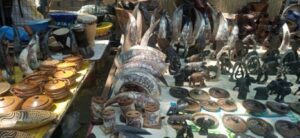
- Cattle horns sold at the Bulawayo City Hall.
-

- Intricate carvings from agricultural byproducts form part of the booming street economy.
The unintended down-stream industries are proving to be a boon for the sector. Buzwani can be found collecting sliced cow hooves, a culinary hit among city imbibers, ensuring steady supply of “raw materials” for the young man’s burgeoning money spinning ambitions. Prepared and sold by self-employed women outside township pubs, the discarded bones are getting another lease of life, from cattle ranches to dinner tables and around people’s necks and wrists. “I have never been formally employed since leaving high school,” Buzwani said.
When a neighbour told him how other young men in the world famous resort town of Victoria Falls were making a decent living out of cow hooves known locally as amangqina, he decided to give it a shot.
“When the pandemic travel restrictions were lifted, I was able to travel with a friend to Vic Falls where he introduced me to his colleagues who converted cattle hooves into salt shakers, necklaces and other small things that are popular with tourists,” he said. “Looking at those curios, you can never tell what they are made from and that these were once living, breathing cattle,” he added. It is a curious connection between the agriculture sector and local innovation, where down-stream industries are being birthed by economic circumstances. Tourist numbers dipped in recent years after the country attracted international bad press fuelled by the violent land reform programme that triggered economic turmoil, but that appears to be changing. Recent official statistics of tourist arrivals show a jump that has also spurred the return of curio dealers.
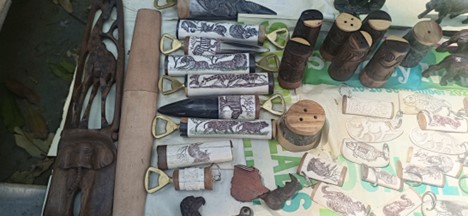
Curios made of cattle horns
Combined with the growth in the national herd, these opportunities are proving to be sustainable. Young men such as Buzwani are enjoying the boom too, albeit unnoticed in the country’s main economic schemes. Government has invested heavily in the agriculture sector, but focus has remained on crops with livestock farming lagging behind. However, for someone like Buzwani who has never been formally employed, being able to make up to USD500 a month from byproducts of the cattle industry is short of a miracle. Government workers such as teachers earn less than what Buzwani makes. Now he is able to take long sojourns away from Bulawayo where he lives with his parents and earn a living in Victoria Falls, the citadel of Zimbabwe tourism.
“My prayer is for the country to be able to attract more tourists and of course more cattle means better livelihoods for many people,” Buzwani said. The country is targeting a USD5 billion tourism economy in the next two years, while aiming for a multi-billion dollar agriculture sector, and it could mean a thriving cottage industry for ambitious young men such as Buzwani.
Related Posts