What homeowners and solar installers need to know about safe working at height
DW_01_REVA_20-05-2026
Whether your motivation for moving to solar is backup power or off-grid living, you need to understand the basic requirements for safe working at height. In South Africa, rooftop solar installations are often the safest and most practical option. However, rooftop work introduces significant risks, and both homeowners and contractors must understand their responsibilities before installation begins.
Johan du Toit, Managing Director of Height Safe 360 (Pty) Ltd, has answered some of the most asked questions.
Personal liability
The first thing every homeowner should know is that you may be held liable for injuries that occur on your property. Make sure that all contractors entering your site have signed an indemnity form and can prove that they are competent to perform the work safely.
Things to keep in mind:
- Has a structural roof assessment been conducted and signed off by a qualified, registered engineer?
- To reduce risk before installation, request a report from a structural engineer. Although this may be costly upfront, it can save you money later in the event of liability or insurance claims.
- In high-wind areas, solar panels can be affected by wind load and uplift forces. Has this been included in the pre-installation planning and calculations?
- Has a proper design layout been completed, including attachment point locations and access planning for future maintenance?
Is the contractor proven competent to work at height?
Competence must be demonstrated in line with the Skills Development Act 97 of 1998. Contractors should be trained and assessed as competent against safe working at height unit standards, preferably the following:
- Unit Standard 229998: Explain and perform fall arrest techniques when working at heights.
- Unit Standard 229995: Install, use and perform basic rescues from fall arrest systems, and implement a fall protection plan.
- Of the two, Unit Standard 229995 is generally more suitable for solar installations because it includes the setup of lifelines, which is especially relevant for this type of work.
- Johan also recommends third-party verification of the training provider and certificates.
A useful benchmark is a licence to operate issued through the approved professional body, the Institute for Work at Height (IWH).
What other training should the contractor have?
In addition to working-at-height competence, Johan recommends that contractors receive the following training:
- Manual handling
- Basic ladder use
- Rope rigging for hauling solar equipment
How will the contractor access the roof safely?
The contractor must use a fall arrest system, which is a system designed to stop a fall safely. The system can be explained through the basic A, B, C, and D components:
- A = Anchor Point: The personal fall arrest system must be connected to an anchor point or anchor line. This may be temporary or permanent. Relevant standard EN 795:2012.
- B = Full Body Harness: The minimum requirement is a full body harness with a rear dorsal attachment point. For solar installations, this is often sufficient. Johan prefers a harness with both front and rear attachment points, as this allows for both horizontal and vertical movement and makes changeovers between systems easier. Relevant standard: EN 361:2002.
- C = Connector: This joins the components of the system. Relevant standard: EN 362.
- D = Deceleration device or fall arrest device: This device reduces the forces generated during a fall to below 6 kN. For an energy absorber integrated into a double-leg lanyard. Relevant standard: EN 355:2018.
How do you apply the system for safe roof access?
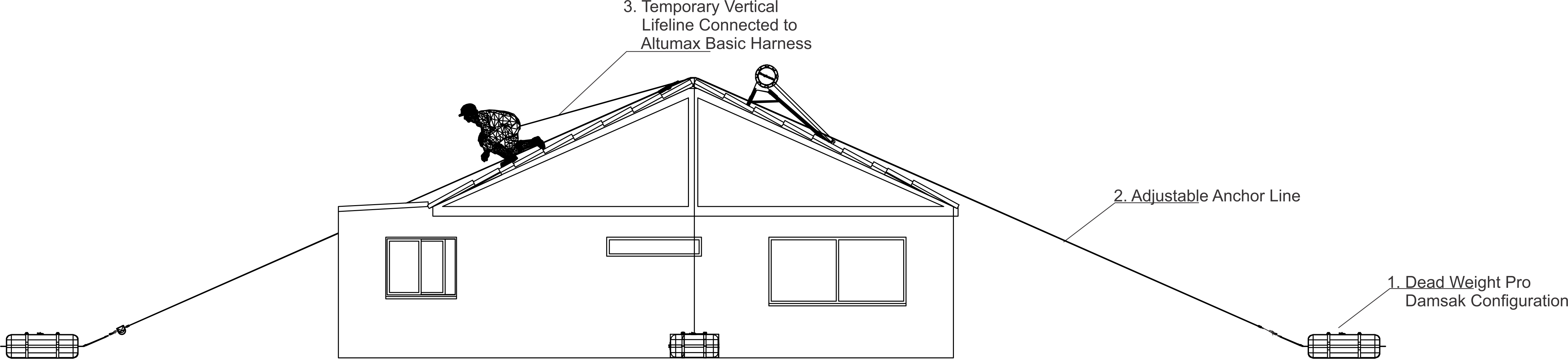
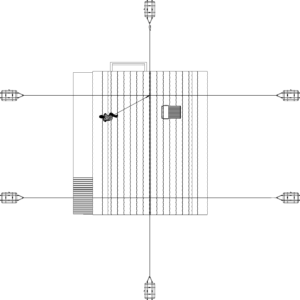
For roof work, a combination of temporary anchor lines can be installed from ground level and used without lifting roof tiles.
- Johan prefers to set up an adjustable rope anchor line that crosses over the roof and is attached at the base of the building.
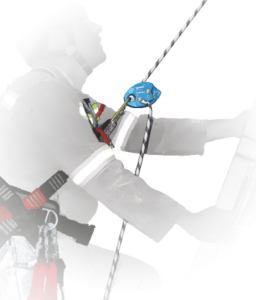
- A tensioning rope anchor line is attached through a double-locking descender. This makes rescue easier, as slack can be introduced into the system quickly in the event of a fall.
- From the main rope anchor line, an alpine butterfly knot can be tied at the roof apex. From this point, a temporary vertical lifeline can be attached, allowing work to be carried out safely in different directions from the main line.
Safe solar installation is not only about electrical compliance. It also depends on proper roof assessment, competent contractors, appropriate equipment and a clear fall protection system. Homeowners and installers who address these factors early can reduce risk, protect lives and avoid unnecessary liability.
For more information about the services offered, send an email to info@heightsafe360.co.za or call 086-112-7749.
Related Posts