HDPE, LLDPE or PVC: Choosing the right geomembrane for your project
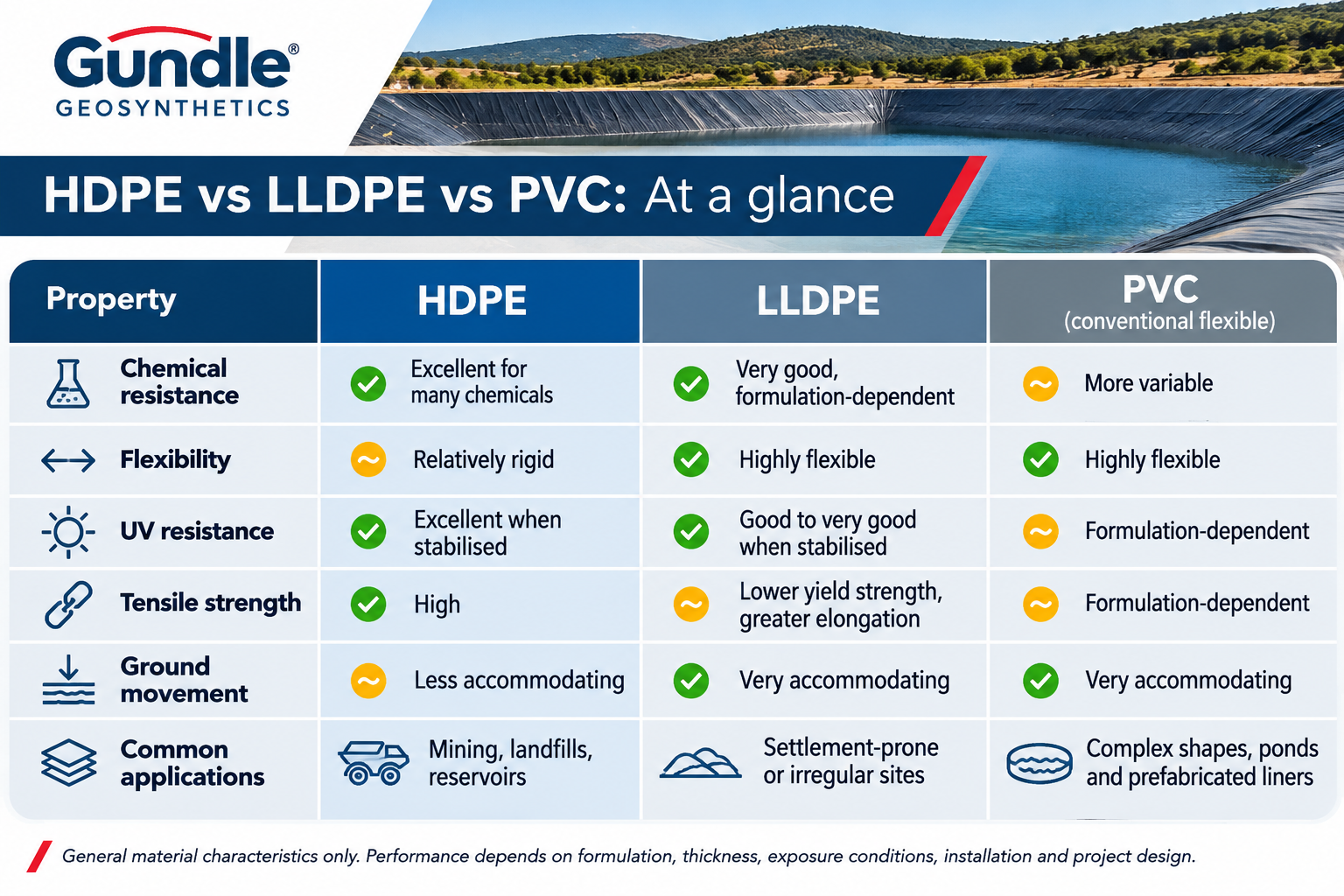
HDPE vs LLDPE vs PVC_ At a Glance
When it comes to protecting valuable water resources, preventing contamination and ensuring the long-term success of infrastructure projects, what lies beneath the surface can be just as important as what is built above it. Choosing the right geomembrane is therefore more than a material decision – it is an investment in the project’s future.
From agricultural reservoirs and irrigation dams to mining operations, landfills and industrial containment facilities, geomembranes play an essential role in preventing liquids and contaminants from escaping into the surrounding environment.
However, not all geomembranes are created equal. High-density polyethylene (HDPE), linear low-density polyethylene (LLDPE) and polyvinyl chloride (PVC) each offer distinct characteristics, making material selection an important part of project planning.
For applications where chemical resistance, durability and long-term performance are critical, HDPE has established itself as one of the most widely used geomembrane materials in the industry.
With extensive experience in supplying and installing geosynthetic solutions across Africa, Gundle Geosynthetics recognises that the success of any containment system starts with choosing the right material for the application.
Understanding the difference
Although HDPE, LLDPE and PVC geomembranes are all designed to prevent liquid migration, differences in their chemical composition and physical properties determine how they perform under varying conditions.
HDPE is a relatively rigid, high-density thermoplastic known for its chemical resistance, tensile strength and ability to withstand ultraviolet (UV) exposure when appropriately formulated.
LLDPE, on the other hand, offers greater flexibility and elongation, making it particularly suitable for applications where the underlying ground may settle or where the liner needs to accommodate movement.
PVC is also highly flexible and well suited to applications involving complex shapes and intricate installations. However, conventional flexible PVC relies on plasticisers to maintain its flexibility, and over time, the loss of these additives can affect the material’s long-term performance.
Understanding these differences enables project owners to choose a geomembrane that best suits the conditions it will be exposed to, rather than simply basing their decision on the initial purchase price.
Why HDPE stands out:
Built to withstand demanding environments
One of HDPE’s most significant advantages is its resistance to a wide range of chemicals, making it particularly valuable in applications where potentially harmful substances must be contained.
Mining operations, for example, often require lining systems that can withstand exposure to process water, tailings and chemically aggressive solutions. In these environments, the consequences of leakage extend well beyond financial losses, as they can also affect soil quality, groundwater and surrounding ecosystems.
HDPE geomembranes provide an effective barrier against liquid migration, helping mining operators manage environmental risks and protect valuable resources.
Their chemical resistance also makes HDPE geomembranes a popular choice for landfill liners, industrial wastewater treatment facilities and evaporation ponds.
However, chemical compatibility must always be assessed in relation to the specific substances, concentrations and temperatures involved in each project.
Designed for long-term exposure
In South Africa and across much of the African continent, geomembranes are frequently exposed to intense sunlight, high temperatures and harsh environmental conditions.
Prolonged exposure to UV radiation can accelerate the degradation of certain polymer materials, making weathering resistance an important consideration, particularly in applications where the liner remains exposed.
HDPE geomembranes formulated with appropriate carbon black and stabilisers offer excellent resistance to UV degradation, making them well suited to exposed applications.
This makes HDPE particularly well-suited to agricultural dams, water reservoirs and other containment facilities where the liner may be exposed to direct sunlight for extended periods.
Although no geomembrane lasts indefinitely, choosing a material with proven weathering resistance can help minimise the risk of premature replacement and reduce the associated maintenance costs.
Strength where it matters most
HDPE offers high tensile strength and good resistance to various forms of mechanical and environmental stress. These properties make it particularly valuable in engineered containment systems where structural integrity is essential.
However, strength should not be mistaken for flexibility.
Because HDPE is relatively rigid, it has a more limited ability to accommodate certain types of deformation than LLDPE or PVC. Poor subgrade preparation, excessive differential settlement or concentrated stresses can increase the risk of damage, including stress cracking.
This highlights why proper design, installation and stringent quality control are just as important as the choice of geomembrane itself.
With adequate ground preparation, appropriate protection layers and carefully executed welding, HDPE can form the basis of a reliable, long-lasting containment system.
When flexibility becomes the deciding factor
Although HDPE is often the preferred choice for demanding containment applications, LLDPE and PVC can offer practical advantages in certain circumstances.
LLDPE geomembranes are designed to provide greater flexibility and elongation, making them particularly suitable for projects involving uneven terrain, anticipated ground settlement or complex geometries.
For example, where a liner needs to conform to changes in the underlying surface, LLDPE’s greater flexibility allows it to accommodate deformation more effectively, reducing the risk of stress concentrations within the material.
PVC offers similar advantages in terms of flexibility and ease of handling. Its ability to conform to irregular surfaces can simplify installation, especially around corners, structures and intricate shapes.
However, conventional plasticised PVC can lose some of its flexibility over time as plasticisers migrate or are lost, depending on the formulation and exposure conditions.
Ultimately, flexibility is only an advantage when it aligns with the specific requirements of a project. In large-scale containment applications where chemical resistance and UV stability are priorities, HDPE may offer a more suitable combination of properties.
The importance of proper installation
Even the highest-quality geomembrane cannot deliver the expected performance if it is not installed correctly.
A successful lining system depends on careful consideration of several factors, such as the underlying soil conditions, drainage, slope stability, liner thickness and potential sources of mechanical damage.
HDPE geomembranes are typically joined using thermal welding techniques to create creating continuous seams between adjacent sheets. These welds must be thoroughly tested to verify their integrity, as poorly executed seams can compromise the effectiveness of the entire containment system.
Gundle Geosynthetics places particular emphasis on quality assurance and quality control throughout its projects.
The company’s quality management approach incorporates relevant Geosynthetic Research Institute (GRI) guidelines, South African National Standards (SANS) and ISO requirements. This helps to ensure that materials and installations comply with the specifications and quality standards required for their intended applications.
By combining appropriate material selection with professional installation and thorough testing, Gundle Geosynthetics helps clients develop containment solutions designed to deliver reliable, long-term performance.
One material, multiple applications
HDPE’s versatility has made it an essential material in containment infrastructure across a wide range of industries.
In agriculture, HDPE geomembranes are used to line irrigation dams, water storage reservoirs and canals, helping to minimise seepage losses and conserve water for productive use.
In the mining sector, they form part of engineered containment systems for heap leach pads, tailings facilities and process water ponds, where effective leakage control is essential for protecting the environment.
Municipalities and industrial operators also rely on HDPE lining systems for landfills, wastewater treatment facilities and other applications where effective containment is required.
Gundle Geosynthetics supplies its Enviroliner HDPE geomembranes in a range of thicknesses and configurations, including smooth and textured options. The product range extends from 0,3 mm to 3,0 mm, with 1,0 mm, 1,5 mm and 2,0 mm among the main stocked thicknesses.
This variety allows project requirements to be matched to factors such as anticipated loading, slope conditions, chemical exposure and the level of protection needed.
Looking beyond the initial cost
When comparing geomembrane materials, it can be tempting to focus solely on the initial cost per square metre. However, the true cost of a lining system must be considered over its entire service life.
Factors such as installation requirements, maintenance, environmental exposure, potential repairs and eventual replacement all contribute to the overall cost of a project.
In suitable applications, HDPE’s chemical resistance and weathering performance can make it a cost-effective long-term investment, particularly where liner replacement would involve extensive excavation, operational interruptions or environmental risks.
Nevertheless, HDPE is not necessarily the most economical choice for every project. Where greater flexibility, complex geometries or significant ground movement are key considerations, an alternative geomembrane may offer better overall value.
Ultimately, the most cost-effective solution is one that meets the project’s technical requirements while ensuring reliable performance throughout its intended service life.
Making the right choice with Gundle Geosynthetics
Selecting the right geomembrane involves more than simply choosing between three materials. It requires a thorough understanding of the environment, the substances to be contained, the expected service life and the conditions the liner will be exposed to.
With more than 3 500 completed projects and over 20 million square metres of HDPE installed, Gundle Geosynthetics brings practical experience to containment projects across Africa.
Through its Enviroliner range and complementary geosynthetic products, the company provides solutions for a wide variety of agricultural, mining, industrial and environmental applications.
While HDPE may not be the ideal solution for every lining application, its combination of chemical resistance, UV stability and long-term durability makes it a compelling choice for projects where reliable containment is essential.
By selecting the right material and investing in professional installation and appropriate quality control from the outset, project owners can protect not only their infrastructure but also the valuable natural resources surrounding it.
For more information about HDPE geomembranes and geosynthetic lining solutions, visit www.gundlegeo.co.za or contact Gundle Geosynthetics on +27(0)11-813-2180.
Related Posts