From small to strong: Boosting growth with sawmilling systems
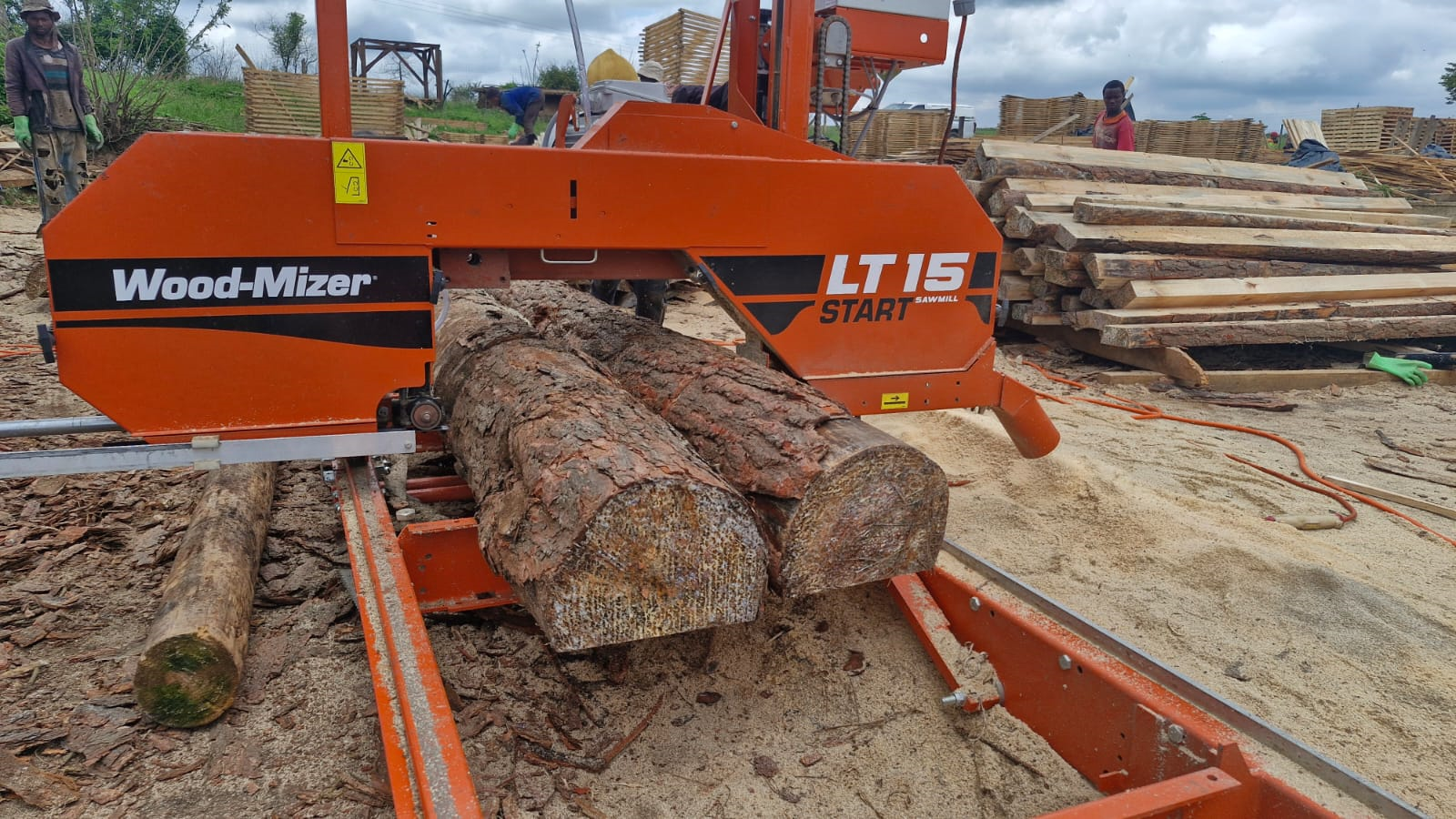
IMG-20241119-WA0012
You’re cutting timber six days a week. Orders are stacking up faster than you can process logs. You know there’s more money to be made. The demand is there, but your current setup has hit its ceiling.
What do you do? Buy a second identical mill? Hire another full crew? Work Sundays? Most sawmillers facing this growth momentum think their only options are to either invest heavily in industrial-scale equipment they’re not ready for or stay stuck at current capacity.
However, ’there’s a third option they’re missing: strategic system design. When primary breakdown, secondary processing, and material handling work as one coordinated workflow instead of separate operations, you unlock production capacity that doesn’t exist in any single piece of equipment.
Small- to medium-sized sawmills can break through to their next level using entry-level sawmilling systems, without the industrial scale investment you might expect.
Understanding sawmilling systems
A sawmilling system integrates three core functions:
- Primary breakdown: Squaring or opening a face on round logs
- Secondary processing: Resawing and edging squared cants into final dimensions
- Material handling: Conveyors, roller tables, and feed systems that link the workflow
Specialisation drives efficiency gains: Specialised equipment handling specific tasks runs faster and more accurately than one machine doing everything.
Output determines configuration
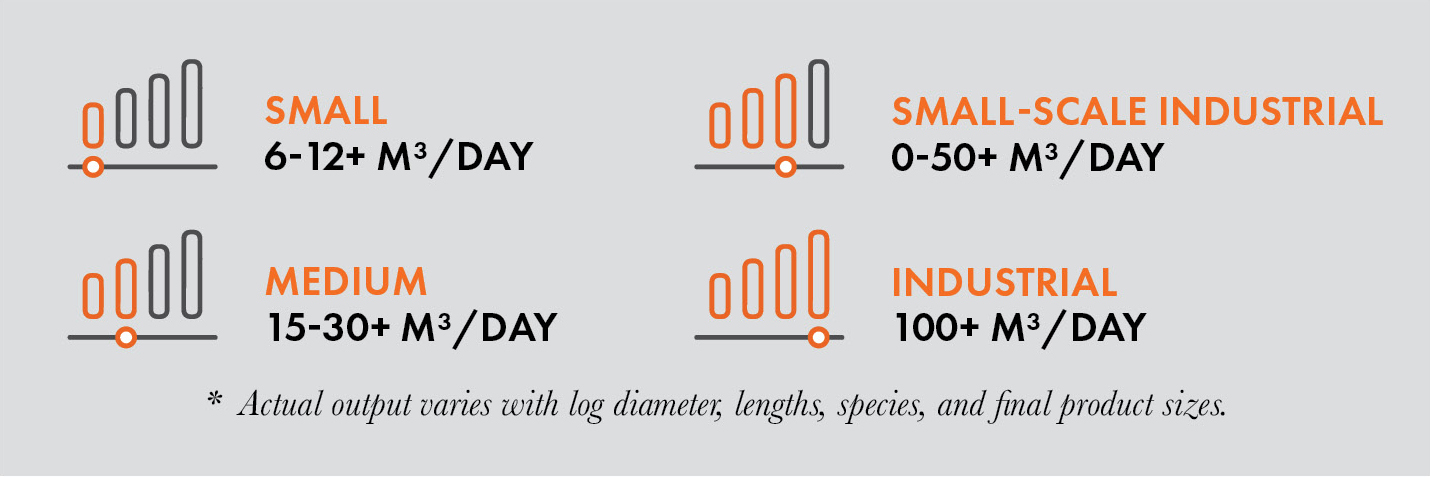
The daily production target of your sawmill, current or planned, will determine your equipment needs. Once the target volume has been defined, a system can be designed that matches both your production goals and budget.
Industry output benchmarks (m3/day):
Entry-level systems building blocks
All-in-one modular
- Combined functions
- Scalable from small to large
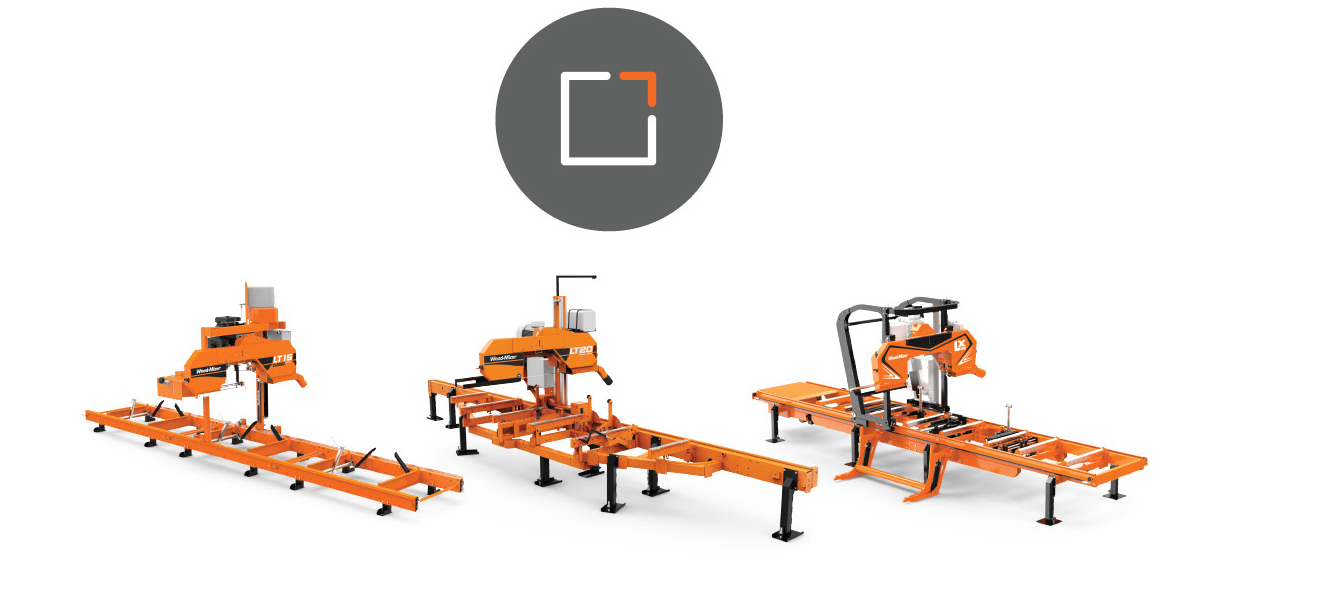
Models
LT range (LT15, LT20, LT40, LT70) and LX range (LX50, LX450).
These portable bandsaw mills combine primary and secondary processing in a single machine. One operator squares the log, then rotates it for resawing and edging, all on the same bed.
Best for:
- Mills producing 6 to 15 m3/day
- Operations with a compact footprint
- Sawmillers who value flexibility to operate in different locations
- Budget-conscious start-ups
Key advantage
Minimal crew requirements (1 operator + 2 assistants) and lower capital investment.
Modular
- Single function
- Scalable from small to large
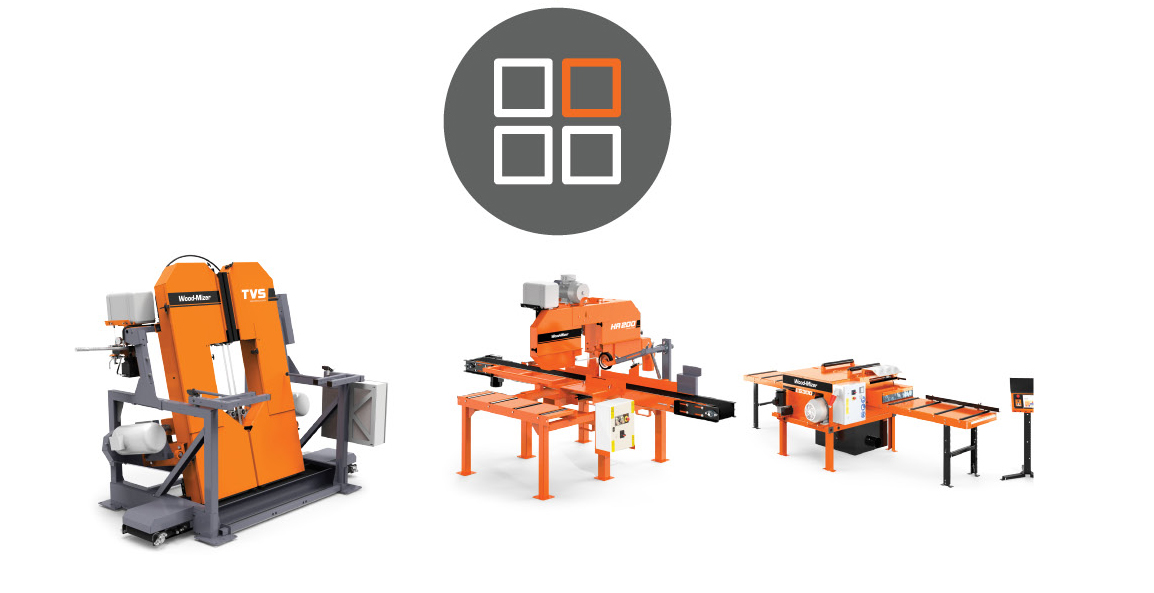
Core equipment
Twin Vertical Saw (TVS), Edgers (EG300), Resaws (HR115). The range spans from entry-level to high-throughput industrial sawmilling equipment, tailored to individual production and budget requirements. Modular systems dedicate separate machines to each processing stage.
Logs move through the workflow: primary breakdown → edging →resawing.
Best for:
- Mills targeting 15+ m3/day
- Operations focused on maximising recovery rates
- Sawmills with consistent species and product mixes
- Businesses ready to scale systematically
The key advantage is that each machine optimises one task, increasing throughput and product quality while reducing bottlenecks.
Combinations
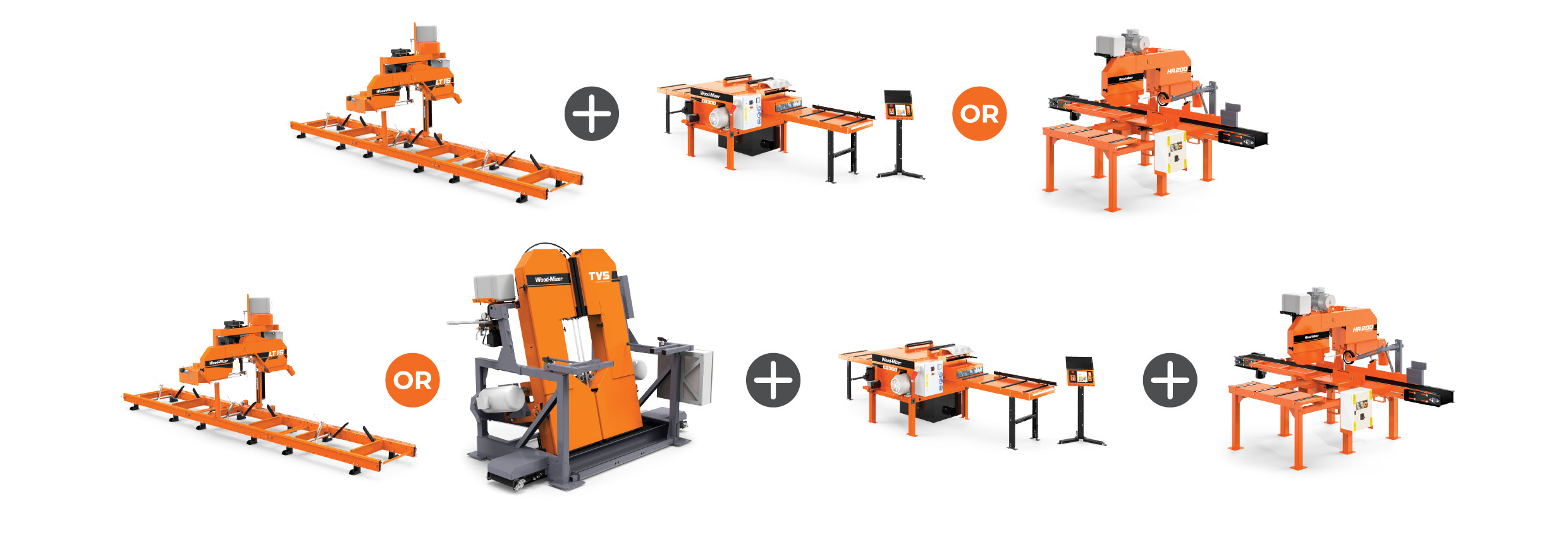
Many growing sawmills start with an All-in-One mill for primary breakdown, then add modular edgers or resaws for secondary processing as production increases. This staged approach lets you scale investment with revenue growth while maintaining flexibility.
Benefits of a sawmilling systems approach
Flexible configurations
Every sawmill has unique requirements based on primary timber species processed, product mix (dimensional lumber, slabs, cants), available floor space and local market demands. Wood-Mizer’s All-in-One and Modular ranges offer the flexibility to create custom systems tailored to individual production requirements and budgets.
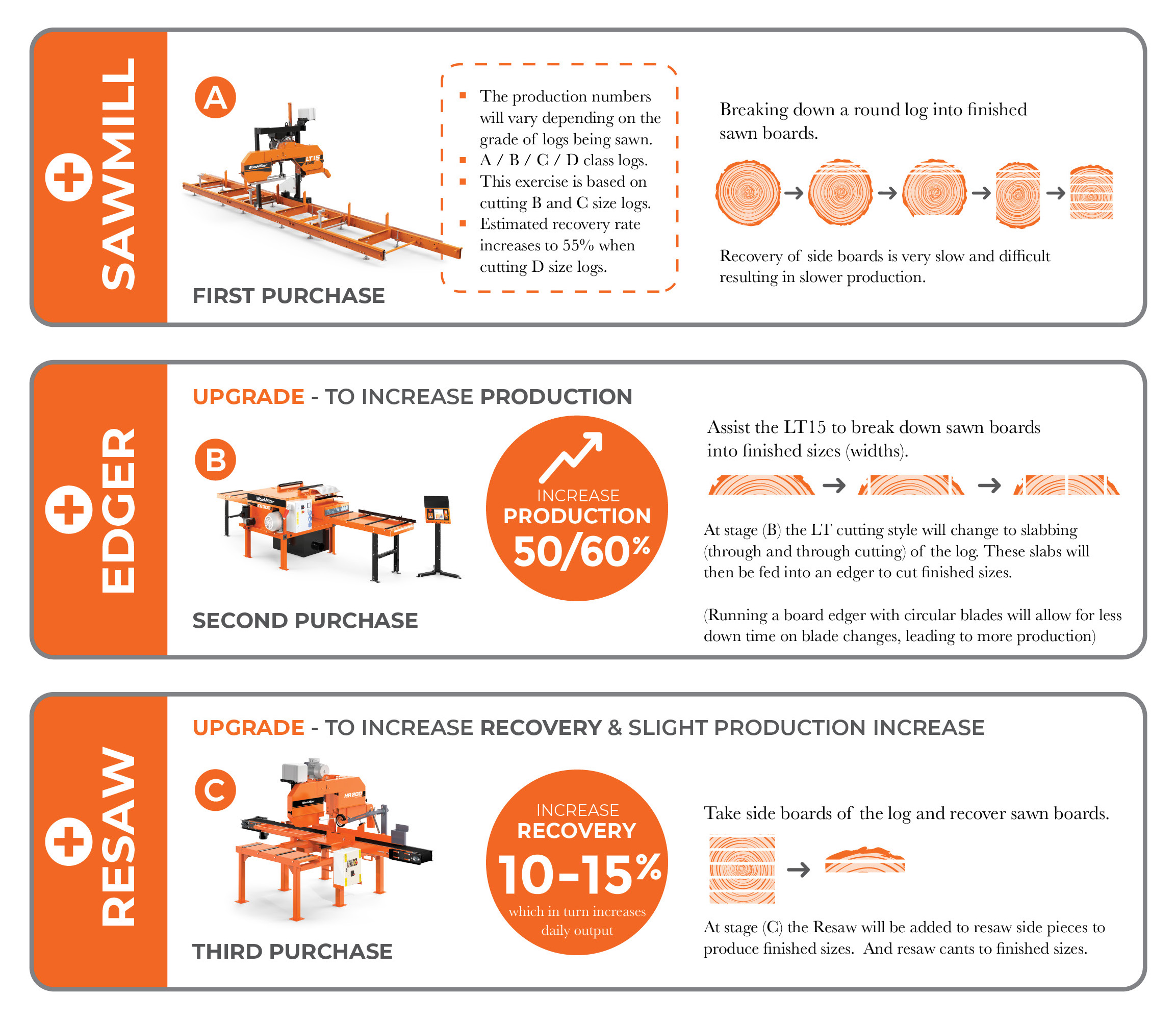
NOTE: To use the LT to cut cants and to then feed them into a resaw to produce finished boards will increase production by cubic metre per shift. However, the size of the cants makes them more difficult to handle, and the quality is dependent on how well the cants are cut on the LT. Cutting slabs on an LT and feeding the slabs into a board edger is a far better option in terms of handling – and you have the advantage of cutting a square board every time as well as producing more timber per shift.
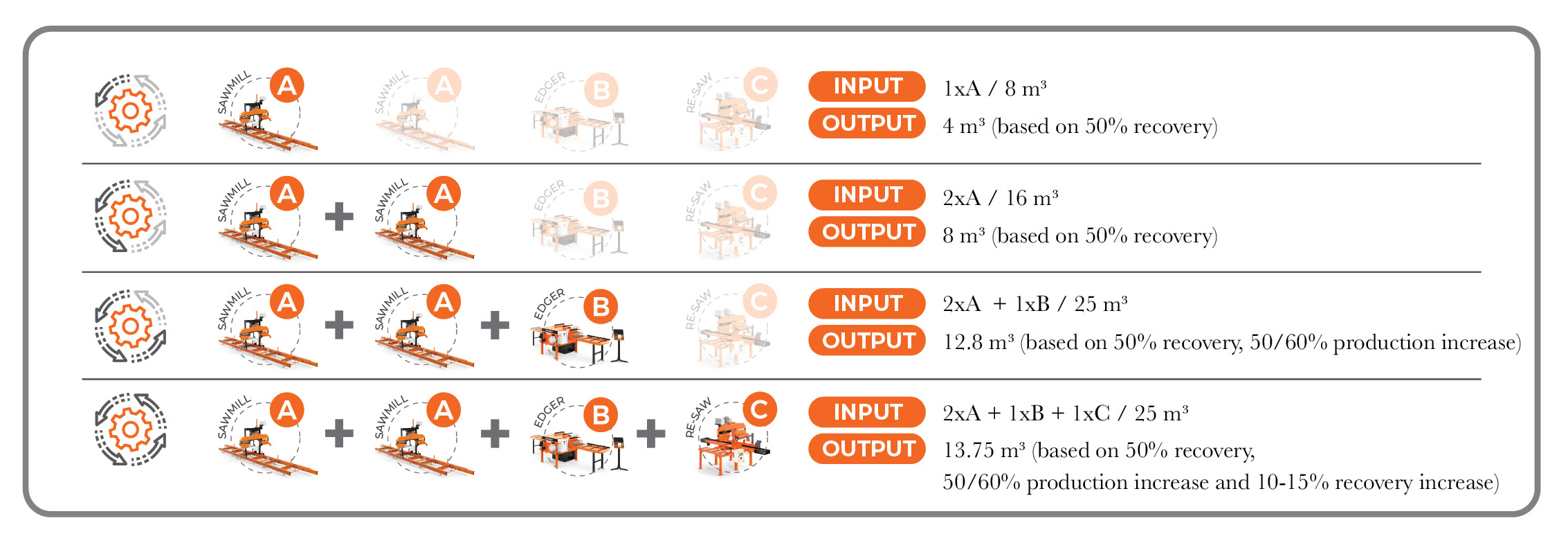
Footnote: Output remains estimates only. They can vary based on: log diameter, log lengths, species, final sizes, and recovery.
Higher recovery rates
Recovery – the difference between log volumes entering a mill and sawn volumes exiting – directly impacts profitability. Wood-Mizer’s thin-kerf bandsaw blades already improve recovery compared to circular saw kerfs. Pair an All-in-One mill with dedicated modular units engineered for precision edging and resawing, and recovery increases further, turning more of each log into sellable timber.
Faster processing speed
Processing speed encompasses log loading and unloading, machine movements, cutting time, and material transfer between operations. All-in-One mills eliminate material transfer but require multiple position changes per board. Modular systems with integrated roller tables enable continuous flow – the edger runs while the primary mill processes the next log.
The advantage is parallel processing, where secondary operations run in parallel with primary breakdown.
Lower operating costs per cubic metre
Labour: All-in-One mills operate with a minimal crew (1 operator + 2 assistants). Modular systems maintain similar labour levels while producing higher volume, reducing per unit labour costs.
Energy: Thin-kerf bandsaw blades in Wood-Mizer’s All-in-One and Modular (Twin Vertical primary breakdown head) ranges require less power than circular saws.
Maintenance: Bandsaw blades cost less to sharpen and have a longer service life than circular saw blades, lowering consumable costs.
Budget-friendly growth path
Wood-Mizer’s equipment tiers let you invest incrementally:
Phase 1: Start with an entry-level All-in-One mill (e.g., LT15).
Phase 2: Add an edger (EG300) as volume grows – often costing less than a second LT mill.
Phase 3: Incorporate a resaw (HR115) for higher-value products.
Phase 4: Upgrade primary breakdown to TVS for full industrial capacity.
This staged approach aligns capital expenditure with revenue growth, avoiding the cash flow strain of over-investing upfront.
Operational simplicity
Task specialisation simplifies training and quality control. Operators develop expertise on specific machines rather than managing multiple processes simultaneously. This reduces errors, speeds up onboarding, and improves consistency, all critical factors for scaling production.
Material handling
The system integrator
Material handling equipment, such as roller tables, conveyors, log decks and outfeed systems, transforms individual machines into an integrated system. Entry-level options include manual roller tables, simple log decks and gravity outfeed rollers.
Industrial solutions offer automated conveyors with programmable logic controllers, hydraulic log turners and positioning systems with automated stacking and sorting lines. Proper material handling eliminates bottlenecks, keeps operators productive, and ensures smooth workflow between processing stages.
Is a system approach right for your operation?
Most sawmilling decisions come down to a simple question: What is limiting my ability to fill orders profitably?
It could be logging supply consistency, skilled labour availability, market access or working capital. A system approach is worth considering when equipment configuration is the constraint. When you have the demand, the logs, the crew and
the space, but your current setup can’t process volume fast enough or efficiently enough to make the economics work, you should consider a system approach.
A system approach makes sense when:
- You’re consistently running at capacity with unfilled orders
- You’re processing high volumes of similar species and dimensions
- :The floor space and budget allow for expansion
- Labour availability supports specialised roles
- Your market rewards the consistency that comes from dedicated equipment
A standalone mill may be the better choice when:
- Production volume fluctuates significantly
- You process diverse species and custom orders, requiring flexibility
- Mobility matters (moving between sites or log sources)
- Simplicity and lower capital investment are priorities
- You have a lean operation where one skilled operator handles everything
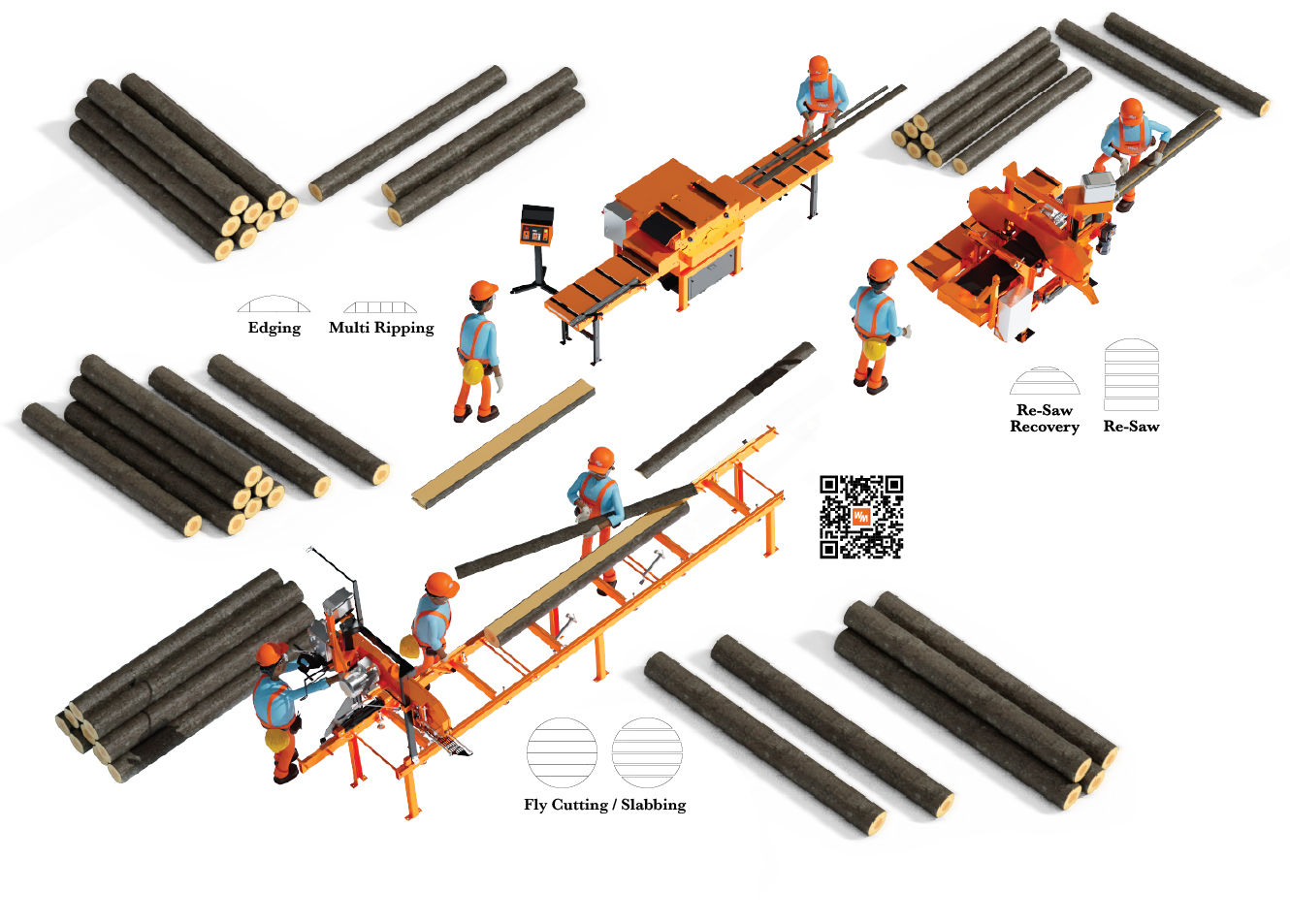
Link to video: https://youtu.be/o4_dvrSQ15U
Click here to see how a Wood-Mizer Sawmill, Resaw and Edger work together to maximise recovery in your production line.
Working with Wood-Mizer
Wood-Mizer offers structured scaling paths that don’t require industrial-scale investment. Support includes production consultations to understand your targets, configuration options tailored to your needs, financial planning with realistic cost projections, and technical support for training and optimisation.
Contact Wood-Mizer by sending an email to enquiries@woodmizer.com. For more information on products, visit www.woodmizer.co.za
Related Posts