Data-driven Canola yields and weed-free fields with Advanta Seeds

IMG_6155
Farmers had the chance to see Advanta’s Canola trials for themselves.
Advanta South Africa is leading a bold agricultural shift by pioneering canola trials in wheat-dominated regions under irrigation, most notably in Hopetown (Northern Cape) and Lydenburg (Limpopo). This initiative marks an industry first, challenging long-held assumptions about where canola can thrive and unlocking new opportunities for rotational and cash crop farming across South Africa.
One of the most compelling advantages of planting canola lies in the performance of the follow-up crop, where farmers consistently report notable yield increases.
Hopetown: A model for rotational success
For the second consecutive year, Hopetown was selected as a trial site due to its progressive farming community and ideal representation of Northern Cape irrigation conditions. During the recent Canola Day, the Advanta team shared impressive results and valuable facts and management to improve canola production:
- Canola Technologies
- Canola Mythbusters
- Canola rule of thumb
- Over 10% increase in maize yields following canola
- Improved soil health and structure
- Effective weed control using CL, TT, and CT technologies
- Strong market returns driven by growing demand for canola oil and meal
Canola is proving to be more than just a rotational crop—it’s a strategic tool for long-term farm productivity.
Driving Canola adoption Nationwide
While Hopetown leads in irrigation trials, Advanta South Africa is expanding its reach:
- Lydenburg (Limpopo): Another irrigation trial site, engaging local farmers and stakeholders.
- Bredasdorp (Western Cape): Dryland trial showcasing Advanta’s new varieties in pipeline
- Caledon, Riversdale, Moreesburg: Dryland trials in collaboration with the Department of Agriculture, SSK, and Overberg Agri.
These Canola Days serve a dual purpose:
- Listening to farmers’ needs
- Sharing valuable production insights
The future of South African farming is growing brighter thanks to innovative agricultural research and cutting-edge seed technology. Leading the charge is Advanta Seeds, whose recent Canola Day event in the Western Cape gave local farmers a glimpse into what smarter, data-driven farming looks like. With promises of higher yields, better weed control, and region-specific seed varieties, Advanta isn’t just selling seed, they’re selling solutions.
Advanta’s recent Canola Day in Bredasdorp
Held in the Bredasdorp, in the Western Cape, Advanta’s Canola Day brought together farmers for a day of learning, networking, and first-hand field inspections.
The event featured guest speaker Justin Kudnig, Advanta’s National Canola Technical Manager in Australia, who plays a key global role in variety evaluation and trade development.
Justin’s insights highlighted how quickly South African farmers are adopting new technologies.
“It is positive to see growers in South Africa are adopting technologies as quick as they are, while also looking at new varieties and technologies. It is a pleasure to come and talk to them about agronomy, varieties and what is the best thing for the South African industry and its evolvement over time.”
Field trials at Grootzanddrift
Attendees visited Grootzanddrift, a mixed farming operation between Bredasdorp and Napier, where Advanta has planted extensive canola trials, including TT (Triazine Tolerant), Clearfield, and Conventional varieties.
Farmer Hercules du Plessis, who manages Grootzanddrift, was introduced to Advanta two years ago. Since then, it’s been a ‘match made in heaven’.
“Having worked in crop trials before, I was immediately on board,” says Hercules. “Our farm is well-located and offers a good representation of the broader region, so the trial results here are valuable to other farmers nearby.”
Their rotational cropping system includes canola, wheat, barley, and alfalfa for grazing, rotating canola back into the system every six years to maximise soil health and break pest and weed cycles.

Gert Els and Hercules du Plessis are discussing the Canola field trials at Grootzanddrift.
Advanta: More than just seeds
Gert Els, Portfolio Manager for Canola and Forages at Advanta Seeds South Africa, says the company’s mission is not just to sell seed, but to provide farmers with valuable data and knowledge.
“We gather information from farmers, understand their challenges, and feed that into our global research,” Gert explains. “By testing varieties under local conditions, we can offer solutions specific to South Africa’s unique climate and soil.”
One major advantage of canola is its adaptability, especially in low-rainfall areas like Grootzanddrift. “Planting different canola types suited to your region and management practices is crucial,” Gert says.
Tackling weed resistance with TT & CT varieties
Advanta has found that an increasing number of local farmers are reporting IMI (imidazolinone) resistance to wheat and barley, making it harder to control weeds.
The solution? Rotate with canola, specifically TT (Triazine Tolerant) or CT (Clearfield + Triazine) varieties. These allow for more flexible herbicide use and can help cleanse the soil before planting other crops.
“By including canola in your rotation, you not only break disease cycles but also combat tough weeds,” says Gert. “And with improved yields today compared to 20 years ago, it’s a smart business move too.”
Advanta, a global pioneer in hybrid canola and continues to lead the charge with their TT and CT innovations, offering farmers more herbicide options and better weed management.
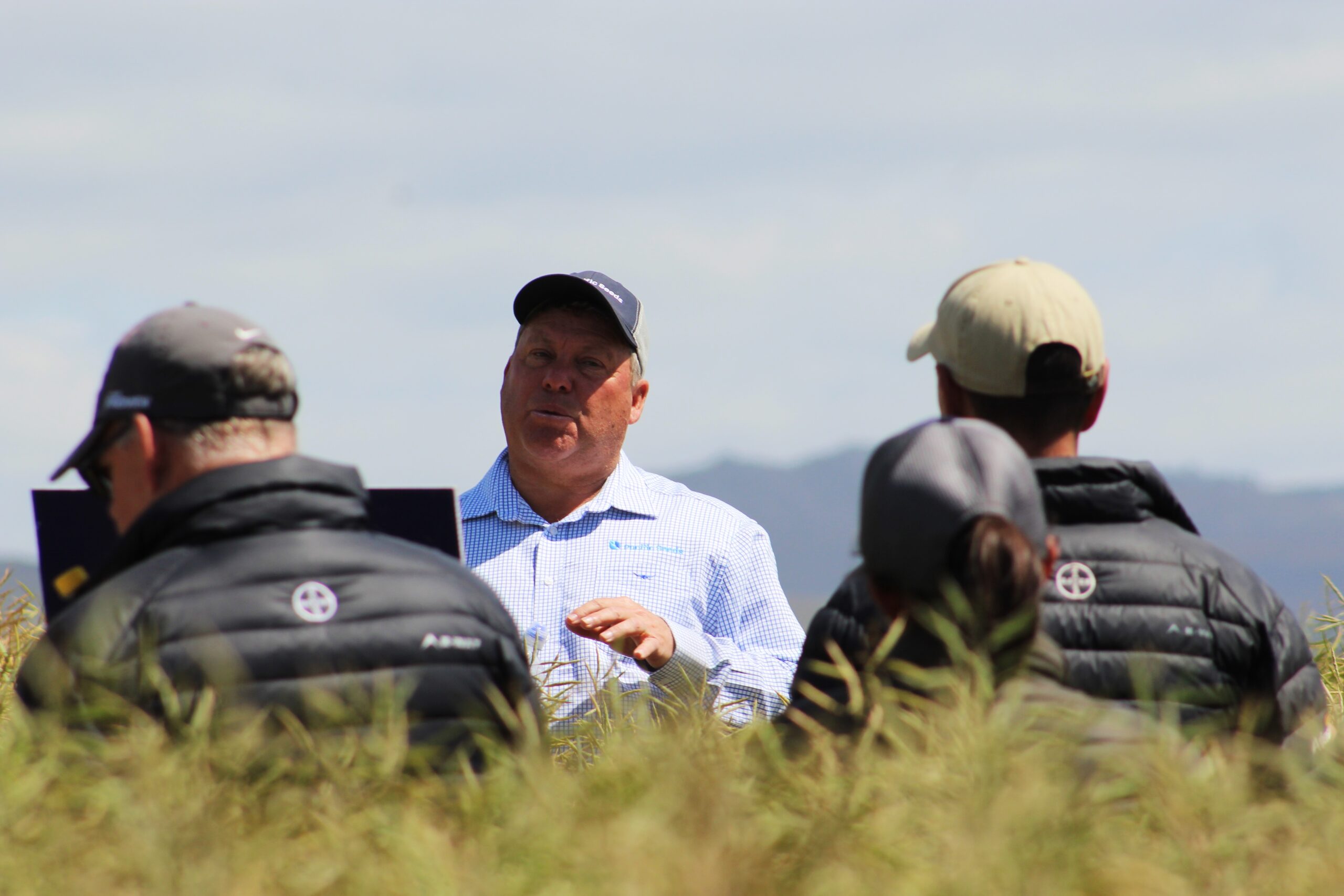
Justin Kudnig is answering some questions from farmers about Advanta’s canola varieties in the field.
The science behind the seed
Behind every high-performing crop is rigorous research. That’s where Apeiro Ag’s Abrie Carstens comes in. His team is responsible for the research and development in the Southern African field trials.
“We’ve worked with Advanta for four years, testing conventional, TT, CT, and Clearfield varieties across different regions,” Abrie explains.
At Grootzanddrift, trials are done under strict statistical controls, each variety is planted at the same density and repeated four times. Despite receiving just 160mm of rain between April 2025 and now, the crops have performed well.
“We expect slightly lower yields due to the rainfall we received,” says Abrie, “but the plants have adapted and compensated. That resilience is exactly what we’re testing for.”
He believes in research as the key to food security: “Years ago, wheat yields averaged five tons per hectare. Now, with research and irrigation, we’re pushing 13 to 14 tons. That progress is only possible with continuous trial work.”
Two countries, one data set
A powerful aspect of Advanta’s program is the integration of South African and Australian data. According to Justin Kudnig, these cross-continental trials are giving researchers strong correlations, enabling better selection of adaptable varieties.
“What works in Australia is increasingly working here,” Justin says. That means South African farmers can benefit from decades of Australian breeding knowledge, accelerating their productivity.
In Australia, the adoption of genetically modified (GM) canola, particularly for glyphosate tolerance, has grown from under 10% to nearly 50% in the last 15 years. This is especially useful in areas with severe weed pressure.
“Where glyphosate is critical for early weed control, GM varieties shine,” says Justin. “But even in non-GM areas, our conventional types continue to perform exceptionally well.”

More canola, more profits
“As more South African growers realise the full benefits of canola, from soil health to weed suppression to higher profits per hectare, we expect continued growth,” says Justin. “And with more varieties tailored specifically for local conditions, the upside is huge.”
Advanta’s goal is not just to sell seed, but to support the entire canola value chain—from planting to processing.
If you are interested in learning more about Advanta’s canola varieties, technologies, or how to get in touch with their team visit their website at www.advantaseeds.com.
Related Posts