Bayer partners with farmers to shape future of tobacco farming
bayer 1
Africa has the potential to produce high yields and significantly increase the stability of the world’s food supply. Bayer’s Crop Science division has noticed this opportunity and is investing heavily in the continent. Bayer has more than a thousand employees spread throughout Africa to assist the farmers in producing better yields.
In Zimbabwe, Bayer has placed special emphasis on the key crops of the region that include maize, potatoes and some vegetables. Tobacco crop protection constitutes a significant proportion of the Bayer Zimbabwe business activities, according to Farai Munyanyi, Territory Manager for Bayer in Zimbabwe. Therefore, Bayer plans the launching of two products specifically focussed on aiding farmers in the fight against pests on their tobacco crops.

These two products to be launched later this year are:
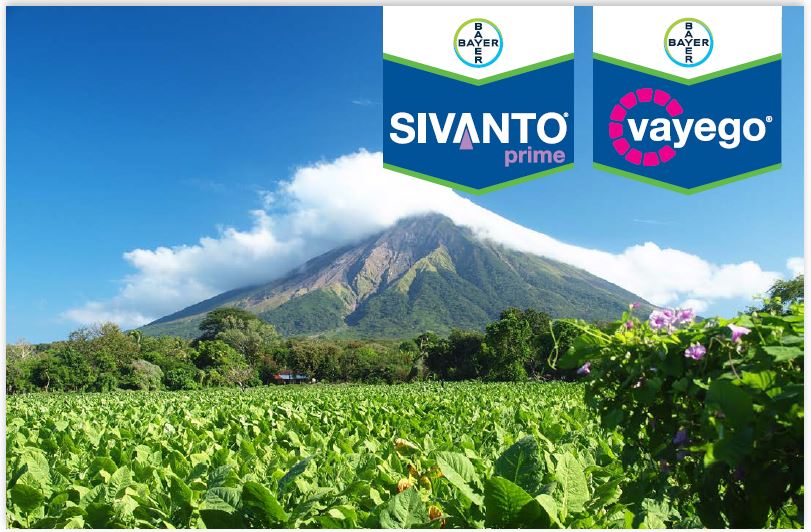
• SIVANTO Prime and,
• Vayego 200 SC
These products have been scientifically formulated to handle specific tasks within the Zimbabwean tobacco industry. Both these products are currently widely used in Europe and other parts of the world across a diverse range of food crops with great success.
SIVANTO prime insecticide has been developed to target aphid infestations on tobacco crops. The active ingredient is Flupyradifurone, which was derived from the Asian plant, Stemona japonica. It can either be applied as a foliar or as a drench application. The SIVANTO prime penetrates the xylem and the phloem of the plant cells. When the insect inserts its proboscis, it gives a bad taste and causes the insect to stop feeding quickly. Thereafter, it affects the central nervous system of the insect causing paralysis.
This ensures that the aphid will not be able to move to a different plant once it has come into contact with the active ingredient of SIVANTO prime, thus limiting the spread of damage to the plants, as well as diseases that are carried by these pests from one plant to the next. SIVANTO prime works fast and has a quick feeding cessation effect on the insects. The results of tests showed asignificant decrease of up to 99% inaphid activity within the first 5 days after initial application.
The recommended mixing rate for SIVANTO prime is 200 ml per 100 ℓ of water (see Sivanto label for instructions). The average application rate per hectare is 500 ml of Sivanto Prime in 250 ℓ of water. To make measurements easier, Bayer has made the product available in convenient packaging sizes.
“In Zimbabwe we have smallholder farmers and large-scale commercial farmers. We understand that they have different needs and that is why SIVANTO prime is available in pack sizes ranging from 500 ml to 1 ℓ bottles,” explains Farai.

Vayego 200 SC has been proven to be highly effective in budworm control. Within four days of application, a very high drop in budworm activity of up to 85% has been recorded during tests. Vayego 200 SC can also be applied effectively as either a foliar spray or a drench application. It reduces plant damage as a result of lethargy, paralysis, rapid feeding cessation and eventual death. It is a plant mobile insecticide that is suitable for application by foliar spray against larval or adult pest stages, but also by drip/ drench application.
The recommended mixing rate is 38 ml per 100 ℓ of water, making it an economical pest control product. The average application rate of Vayego is 95 ml in 250 ℓ of water per hectate. Packaging
sizes have also been adapted to the needs of both small-scale and commercial farmers. This makes the mixing process convenient and also minimises the risk of wastage and accidental exposure to the environment. Bayer has a long-standing relationship with farmers, and Bayer Zimbabwe is no exception from this policy.

The company understands the needs of farmers and considers farmers to be their business partners rather than their clients. Farmers who wish to combine these two pesticides to ensure optimal pest control on both aphids and budworms may contact their nearest supplier for the necessary expert advice.
Bayer Zimbabwe has six distribution points throughout Zimbabwe, and also supplies products to other distributors within the agricultural industry. Their products are easy to access and simple to use. “A farmer may simply contact us, and we will provide a tailor-made solution for the problem,” says Farai.
Bayer realises that they do not only have a responsibility towards farmers to increase their yields, but also to the environment to ensure that their products do not cause harm to beneficial insects. Bayer takes the preservation of a region’s natural biodiversity very seriously. Therefore, great care has been taken to ensure that SIVANTO prime confers low risk to honeybees even when applied to flowering crops during bloom. Vayego 200 SC has a high intrinsic toxicity to bees when applied as a foliar spray, avoid spraying at bloom but after flowering. Vayego poses no risk to bees when applied as a drip or drench.

Bayer is committed to creating pesticides with a low risk factor to the environment without compromising the efficacy of the product. That is why each pesticide is developed to target only specific pests instead of killing a broad spectrum of insects.
The farmer’s responsibility is to use the product as directed by the product label. Great care goes into creating these guidelines for the farmers and they should not deviate from the instructions. The instructions on the label are not only intended to minimise the risk to the environment, but also to ensure the safety of the farmer while using this product.
For more information on these and other Bayer products available in Zimbabwe, farmers may contact Farai Munyanyi on +263-772-131228 or send him an e-mail to farai.munyanyi@bayer.com. Farmers can also visit http://www.cropscience.bayer.co.za, or http://www.bayer.co.za for more information on Bayer and its products.
Related Posts