Agroforestry in Kenya part 8.5: Agroforestry systems in arid and semi-arid lands

kenya 18
In the previous two articles we focused on agroforestry in humid highlands and humid lowlands. The arid and semi-arid areas (ASALs), however, cover the largest part or 80% of the total land in the country. These areas include the lower eastern counties, northeastern counties, part of the north, the central and south rift, as well as pockets of areas in the western Kenya region.
The annual rainfall is 150 mm to 600 mm and these areas often experience long periods of droughts and hunger. The main agricultural activities include livestock and crop cultivation if intermittent rainfall allows.
Common agroforestry practices include:
Boundary planting and live fences
Species like Euphorbia tirucalli (milk bush) Cassia siamea, Melia volkensii, leucaena spp, Croton megalocarpus, Cupressus lusitanica (Mexican cypress) and Grevillea robusta (silky oak) are planted for farm boundary demarcation, soil erosion control, protection from intrusion into farms and homes, wind breaks, fuelwood, construction poles and timber, and to beautify the homestead.

Fruit orchards
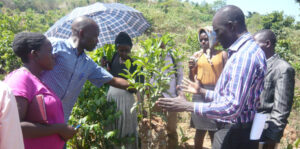
Exotic fruit trees like mango and papaya, and indigenous fruit trees like Tamarindus indica or tamarind, S. cuminii or black plum, Lannea stuhlmanni or false marula, Sclerocarya birrea or marula, Adansonia digitata or baobab, among others. These are used for household nutrition and generating an income.
Farm forestry, specifically woodlots
Woodlots of Melia volkensii (melia tree), Eucalyptus camaldulensis (red river gum) and Azadirachta (neem) are planted for timber, construction poles and posts. Neem is also planted for oil for medicinal purposes. Senna siamea (kassod) is planted for its medicinal value, while Acacia species are planted for fuelwood, gum and resins, the latter of which also have medicinal purposes.
Homestead planting includes Cassia siamea, Melia Volkensii and Melia Azedarach, Acacia spp, Balanites aegyptiaca (Egyptian balsam) and Mangifera indica (mango) among others, for shade, as a windbreak and fruits for household nutrition.
Scattered trees in croplands
Grevillea robusta and Terminalia brownii are planted to prevent soil erosion and shade for crops, animals and herders during blisteringly hot seasons.
Croton megalocarpus or croton tree, mangoes, and Passiflora edulis (granadilla) are planted in home gardens for fuelwood and fruits.
For alley cropping or hedgerow cropping Leucaena spp, Acacia saligna, Calliandra calothyrsus (red powder puff tree), Sesbania sesban (Egyptian river hemp) and Passiflora edulis are planted. The purpose is mostly soil improvement and the protection and stabilisation of the soil structure, as livestock fodder, fuelwood, and fruit as food.

Fodder banks
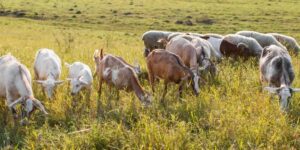
Sesbania sesban, Croton megalocarpus and Dombeya cosanii are planted in Napier grass to provide fodder during the dry seasons and to improve land productivity. Acacia spp, B. aegyptiaca, and other indigenous tree species provide fuelwood, pasture for livestock, construction materials, medicinal value, and the restoration of degraded land.
Parkland agroforestry systems
Parkland systems was discussed in a previous article Agroforestry part 5: Parkland systems of Africa (https://www.proagrimedia.com/innovation/agroforestry-part-5-parkland-systems-of-africa/)
Trees scattered in ASAL rangelands, along with native grass species regenerated alongside Acacia spp. and Zizyphus mauritiana (Indian jujube) provide livestock forage and fruit. These are also used for the rehabilitation of degraded rangeland.
Context of agroforestry practice in the ASALs
Agroforestry practices in the humid lowlands have been practiced in the following context:
Livelihood and resilience strategies
Conditions in arid and semi-arid land are harsh and dry and there are very little meaningful rain-fed crops are grown. Tree planting targets high value tree species such as timber and fruit trees so the products can be sold to boost family income. Although the trees may not flourish with as little water as is available, they are well taken care of because they improve the resilience of farmers against climatic challenges.
Land degradation
Livestock offers the most promising enterprise, but pasture degeneration as a result of overstocking leads to conflicts among communities and humans and animals in wildlife protection areas. Sustainable rangeland management and sustainable grazing management have shown potential to improve regenerative land restoration, in which agroforestry could play a role. An effort should also be made on grassroot level to foster peace and reduce conflict.
Largescale farming with mechanisation
The land size in semi-arid areas is extensive and is suitable for large-scale farming of wheat farmers, such as in Narok County. In such a farming system, agroforestry is seen to be in conflict with mechanisation, but the right tree species and proper design of tree-crop configuration could help solve the problem.
Related Posts