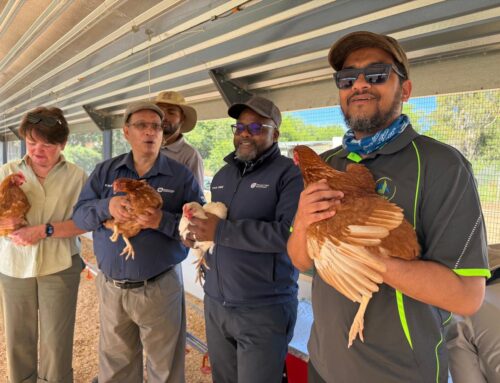
Marquis Macadamias farmers commit to climate and social upliftment

Clayton Mattiazzi, General Manager of HPP[44][39]
As an industry focused on well-being, macadamia farmers and processors have committed to achieving the ‘better and more sustainable future for all’, as set out by the United Nations’ Sustainable Development Goals (SDGs). By focusing on soil health, carbon sequestration and socially uplifting initiatives, the macadamia industry is continuing to make a meaningful impact in the world.
In a first for the macadamia industry, Marquis Macadamias shareholder/supplier Hinkler Park Plantations has demonstrated that practices to promote soil health and fertility can significantly reduce greenhouse gas (GHG) emissions and increase GHG removals via soil organic carbon (SOC) improvement.
Carbon reductions refer to a decrease in GHG emissions, achieved by using less fertiliser, chemicals, or energy to produce the crop. Carbon removals refer to the capture and storage of CO2 from the atmosphere, in this case, via soil carbon sequestration.
Hinkler Park Plantations, a 3,000-hectare macadamia farm based in Bundaberg, Queensland, has achieved total greenhouse gas (GHG) reduction and removal of 17,670 tonnes (t) of carbon dioxide equivalent (CO2e) between 2020 and 2021 across its entire macadamia production system through carbon sequestration and cutting energy and fertiliser use.
This is the equivalent to offsetting the emissions from 4,236 passenger vehicles for an entire year. Hinkler Park Plantations Queensland General Manager and Marquis Macadamias Director Clayton Mattiazzi said by going back to basics, Hinkler Park Plantations has completely revolutionised its farming operations.
“This time eight years ago, we were struggling with soil health, tree heath and yields. By implementing biological farming practices, we have completely reinvigorated the health of our farm and quality of our macadamias,” Clayton said.
“We did this by creating a media of nutrient rich material to optimise growing conditions for our macadamia trees.
“The key to this was repurposing the excess organic matter within the farm: prunings, inter-row grass clippings and nut husk were all moved back under the tree into soil to compost this material into food for our trees. This activity is supported with large anaerobic composted mulch that is made from excess farm waste.
“What we have created now is a farm that sequesters more carbon than it produces, preparing us for climate change by building a biologically healthy and more robust farming system.”
An independent audit conducted by sustainable food certifier Carbon Friendly found the GHG emissions intensity of macadamia nuts produced at Hinkler Park reduced from 302 to -2,816 kg CO2e per tonne of macadamia between 2020 and 2021.
The Greenhouse Gas Emission Reductions & Removal Enhancements Report found that soil carbon improvement contributed to the removal of 2,935 kg CO2e per tonne of macadamia nuts during this period.
Farm workers are of the most vulnerable populations in societies across the African continent, where education levels remain low. Marquis Macadamias grower, AgriStar, based in the Lowveld of South Africa, approaches sustainability holistically under the blanket of good governance. Focusing on education and skills transfer within their workforce, they are working toward building resilient communities.
Through environmental stewardship and employee development, AgriStar is driving rural transformation. Director of AgriStar, Roelof van Rooyen explained that they have partnered with several communities on commercial-scale macadamia farming projects.
“These community farming projects allow us to share our extensive knowledge of the production of macadamias and in so doing create stand-alone and commercially successful agri-businesses,” Mr van Rooyen said.
“These community partnerships also leverage Agristar’s sustainability philosophy. This develops their own sustainability framework, allowing for significantly positive socio-economic upliftment to take place within the immediate and greater surrounding communities.
“It is a win-win for the whole industry, as we move towards greater achievement of the SDGs.”
Marquis Macadamias CEO Larry McHugh said growers across the global macadamia industry were taking advantage of the macadamia tree’s natural resilience to improve sustainable growing practices and productivity. The economic potential of the crop also meant that communities surrounding farms were poised to benefit.
“It is vital that Marquis Macadamias and our growers work together to not only meet the needs of the present but preserve the land for future generations so that farming communities and economies can continue to flourish”,” Mr McHugh said.
“The initiatives focus on ensuring healthy land and soils, optimising water, energy and electricity usage, waste management, and orchard management.
“Not only do macadamias taste good and have a multitude of health benefits, but their sustainable production can also have positive impacts on the environment. As strong advocates for the sustainable production of macadamias, our facilities and growers are leaders in setting industry standards.”
Source: Marquis Group
Related Posts