Land Bank se finansiële uitslae wys stabiliteit

tp-nchocho-low-res
Land Bank het steeds daarin geslaag om sy leningsboek met 3,2% te groei en rapporteer ‘n toename van 27% in hulle wins en dit terwyl dit ‘n slegte ekonomiese jaar is. Lees die volledige persverklaring hieronder:
During the year under review, the Bank’s earnings growth was driven by cost containment and net interest income, which rose 4,8% to R1,2 billion from the previous year. A number of non-recurring expenses had an impact on the overall performance of the Bank including the organisational review costs of R162,7 million as well as the once off adjustment to the carrying value of liabilities amounting to R50,8 million. Excluding these items, operating cost increased marginally by 0,9% and the Bank achieved a pleasing cost to income ratio at 56,0%.
Total loans grew marginally by 3,2% (R1,2 billion) to R39 billion from the end of last year. The slowdown foreshadows the challenges that the agricultural sector has had to cope with. Against the backdrop of the drought which plagued large swathes of maize producing farmlands during the reporting period, the Bank changed its impairment methodology to adopt the requirements of IFRS 9, resulting in its coverage of impairments to non-performing loans increasing to 77,2%. Not only did the Bank manage to meet all its financial corporate targets, it is the first bank in the country to implement IFRS 9 standards.
Land Bank Insurance Company (LBIC), the short term insurance arm of the Bank recorded a profit of R13,6 million (FY2015: R43 million loss). Its gross premiums increased by more than 100% to R405,9 million from R138,4 million in the previous year. Speaking at the Annual Results presentation, TP Nchocho, CEO of Land Bank says, “The results are testament to the resilience of our business model and reflect our continued focus on executing our growth strategy.”
At the request of the National Treasury, Land Bank embarked on an organisational review and balance sheet restructure during the year in review to optimise efficiencies and reduce costs, develop an appropriate funding model for agriculture Development Finance Institute (DFI), and improve the sustainability of the Bank’s capital base.
“The review we undertook as a strategic imperative highlights our efforts to spur stronger growth and enhance inclusivity in the sector. During 2016, Land Bank reviewed its overall strategy and put salient business pillars in place to improve its development effectiveness, operational efficiency, and financial sustainability. The review afforded the Bank an opportunity to build a solid foundation that remains profitable even in the wake of a sector challenged by economic and climate risks”, says Nchocho.
“Following the redesign, we are best positioned to address effectively the development priorities that are encapsulated in the National Development Plan, with particular focus on growing the agricultural sector on an inclusive and transformative basis,” added Nchocho.
The Bank furthermore developed a number of Basel II and Basel III capital adequacy and funding models to enhance comparability with the industry. The Basel II capital adequacy ratio and Basel III Net Stable Funding Ratio and Liquidity Cover Ratios have given the Bank the impetus to further strengthen the quality of the Balance Sheet. The Bank achieved a healthy Basel II total capital adequacy ratio of 18,8% which is well above the Bank’s internal target of 15,0%.
In 2016, Land Bank approved loans to the value of R11,4 billion. The potential impact of the Bank’s lending approvals on GDP is estimated at R12,1 billion, whereas the actual estimated development impact of the Bank’s disbursement on GDP is estimated at R39,1 billion. These significant economic effects constitute a major contribution towards achieving the Bank’s mandate of inclusive and transformational growth.
The Land Bank is also exploring a number of approaches with the government and other like-minded DFIs in an on-going attempt to improve access to finance especially to emerging and black farmers. Total loans and advances extended to this market segment amounted to approximately R2,5 billion as at 31 March 2016.
“I am happy to say that Land Bank’s transformational agenda is on course and yielding results. We are driven by the belief that a stronger Land Bank will be geared to drive enhanced contribution to the sector and translate the opportunities into real development outcomes on our journey to being a world-class agricultural development bank,” concludes Nchocho.
Bron: Magna Carta
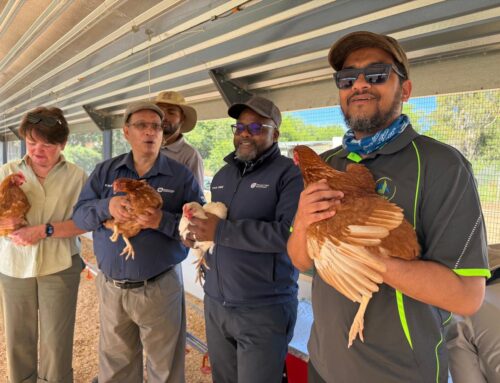
Foto: TP Nchocho, CEO of Land Bank
Related Posts