Firefighting: Plan ahead so you’re not caught off guard
fire 1
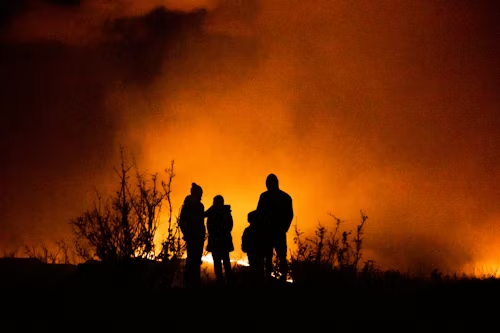
It is important to keep people who are not directly involved in fighting a fire away from the scene. (Source: Caleb Cook, Unsplash.com)
The Namibia Agricultural Union (NAU) has compiled a list of things you should do to prevent runaway veldfire. The list includes tips on being prepared for a fire, managing a raging fire, safety tips and more.
According to the NAU’s newsletter, good rains have fallen in some areas, leaving pastures lush and animals well fed. The best time to think about firefighting is when the grass is green, however, remember that the grass will wither and die during the dry season, leaving highly flammable biomass on the land. One lightning strike, a carelessly tossed cigarette butt, or a spark while mending fences can turn into an uncontrollable inferno within seconds.
Although circumstances differ on farms, these guidelines provide a meaningful list of dos and don’ts that can be adapted to suit your own needs.
Plan ahead
Consider the following to help secure your farm in the best possible way against fires:
- Have emergency phone numbers ready to report a wildfire.
- Have farm maps that indicate all roads and water sources. Make sure all water points and dams are accessible for filling up water tanks.
- Buy two-way radios, which work better than cell phones, to communicate with your team of firefighters, neighbours, farmer association and fire authorities. If possible, choose a fire captain who can coordinate information and feed the firefighters with this information from his car. Two-way radios are more useful than cell phones in such a situation.
- Keep your firefighting tools in one storage place and keep the fuel tank of your vehicle, fire extinguishers and petrol cans full.
- Train your workers to fight fires and equip them with adequate personal protective equipment. Provide all helpers unfamiliar with the farm with a map of the property, which indicates roads, fences, dams and storage tanks.
Clear borders
- Clear the border roads of your camps.
- Enlarge resting spots for your livestock and bare spots around feed or water troughs to create safety zones in each camp.
- Don’t wait for the Roads Authority (RA) to mow the grass on the road reserves along main roads. Mowing teams need written approval from the nearest RA office before tractors and mowers are allowed onto road reserves.
Around your home
Reduce the risk of fire on your property by cutting long grass, pruning trees, removing leaves from gutters and pruning plant material that can serve as fire ladders on buildings. Create a defensible space of approximately 20 m between the buildings on your property.

Formal firefighting teams use a spotter plane to assess a fire from the sky, but the same can be done with a drone. (Source: Filippos Sdralias, Unsplash.com)
Firebreaks
- Each farmer should divide his farm crosswise into four quarters, each surrounded by a wide firebreak. Then you can burn one quarter and save three.
- Prepare firebreaks around and through the farm before the grass is completely dry. Make sure your team takes along fire extinguisher equipment when making firebreaks.
- Before you burn flammable materials, you must obtain a fire permit from the local fire protection association. Also inform your neighbours and the local farmers’ association of your plans.
- Check the weather forecast and danger index before you decide to make firebreaks or burn garbage – don’t do it on a hot, windy day when strong winds are predicted.
- Firebreaks should preferably be made in the evening when it is cooler, and winds are calmer.
Firefighting equipment
- Ensure all firefighting and support equipment – including water carts, pumping units and tools, such as a spare wheel, a jack and a wheel wrench) – are in good working order.Every vehicle should have an axe, a shovel and a light chain. The axe can be used to cut down branches, which can be pulled to a central point with the chain. The shovel is handy if you get stuck in a hole, and there are holes aplenty where aardvarks and other burrowers occur.
- Every vehicle must have wire cutters to cut a fence should you or your animals get cornered by a fire.

Remove vegetation along walls, which can be used as a fire ladder to jump to your house or your barn’s roof. (Source: Benjamin Lizardo, Unsplash.com)
Wildfires
Report all wildfires to the authorities. Notify your neighbours and the applicable fire associations as soon as possible. In the absence of the landowner, a responsible person must be on or near the property to fight fires.
It is important to make the land accessible to firefighters and their vehicles, so there must be someone who can open gates and switch off electric fences. Fire trucks are approximately 4 m high, so it is necessary to ensure that these vehicles can easily drive under trees and electricity and telephone poles.
When driving or working in the veld
Be very careful when cutting or welding steel close to dry grass, as the sparks can ignite the grass up to 10 m away.
Never cut and weld alone in the field. Keep fire extinguishers nearby and spray the surrounding dry grass with a small 5-litre hand sprayer beforehand.
Regularly remove grass and seeds from the grille, exhaust pipes and undercarriage of your vehicle. If the exhaust pipe is hot, it will set any loose grass lying on it and the field on fire. Also, don’t stop your vehicle in tall, dry grass.
Carbon dioxide
- Stay out of valleys and gulleys as carbon monoxide accumulates in low-lying areas. A lack of oxygen will make you unconscious – and the fire will catch up with you.
- If you have to drive through a fire, the lack of oxygen can cause your vehicle to stall. Gain enough speed before you drive through the flames.
- Always take a valve spanner with you. If your vehicle gets a flat tyre, unscrew the valve and pump up your tyre with water from the fire extinguisher. Screw the valve back in. Drive slowly because the wheel will be unbalanced.
- Always take a flashlight or headlamp with you to the fire. Most fires are extinguished when it gets cooler – usually after sunset.
- Take enough drinking water and salty food with you for your team.
Counterfires
- Make sure you have information on wind directions before you start a counterfire, or you might start a new fire.
- If you don’t have a drip torch, a 9-kg gas bottle with a burner helps to quickly start a counterfire.
- Clear roads by dragging large pieces of bush out of the way. Use a saw or axe to cut down branches and a chain to drag them away.
- If you are using a bulldozer to clear fire roads and have piles of fallen trees and bushes all over the place, make sure there is no grass around them. If these piles of wood catch fire, the flames can easily jump the road; a strong wind can sweep the fire 50 m or even further.
- If you can’t put out the fire by noon, discuss with your team where and how to make firebreaks – or wait for the fire to come to you in an open stretch of road. It is no use attempting to fight the fire if you know you can’t beat it. Rather, wait and get your fire extinguishers ready.
- Be wary of fires that have the shape of a hand, as you can get trapped between the “fingers.”
- While professional firefighting teams use a spotter plane, a drone can give firefighters on the ground a good overview of what the veldfire looks like from above.
Keep in mind that a fire needs three things to burn: flammable material, heat, and oxygen. If you remove any of the three, you can extinguish the fire. Water cools the fire, and the droplets push away oxygen. Always spray water as low as possible into the fire, because spraying it into high flames only evaporates the water. A fire blanket thrown over a relatively small fire will also cut off the oxygen and kill the fire. Rake away flammable material.
-

- Beware of a fire that is burning in a mountainous area, as carbon dioxide gathers in the lowest areas of gulleys and valleys. (Source: Malachi Brooks, Unsplash.com)
-

- Inform your local fire authority, agricultural union and neighbours if you plan to make a firebreak. (Source: Malachi Brooks, Unsplash.com)
Aftercare
Aftercare is extremely important. Walk the fire line with the team and extinguish smoking or burning logs or rake them into the burnt veld. Tree roots burn underground and may start a new fire, while burning trees that fall over can also start a new fire.
Source reference
NAU Newsletter 17 April 2026
Related Posts