All about flies – an Afrivet 101
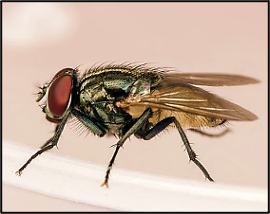
Flies
Shoe, fly! Don’t bother me!
We know they exist, and we know when they are most active, but do we truly know just how detrimental they are to our health, to the health of our livestock and pets and therefore how to control them in the right manner?
Flies belong to the order DIPTERA and there are currently 91 families of flies in South Africa. Several of these families and many fly species are important to stock-farmers.
The two species most seen on farmyards belong to the family Muscidae: House flies (Musca domestica) and stable flies (Stomoxys calcitrans). However, there are many more species that can play a role in animal health.
It is important to understand the life cycle of insects to manage their numbers effectively and, for effective fly control. Understanding the life cycle allows strategic and tactical application of control measures to reduce fly numbers and to decrease production losses and treatment expenses.
The whole life cycle of a fly can be completed in 7-15 days, depending on the fly species. Only 15% of the population of flies are adults. House and stable flies lay their eggs in organic matter like manure, compost, and kitchen waste. Blowflies lay their eggs on rotting animal carcasses. An adult house fly can lay 500 eggs during its lifetime. Blowflies can lay 2000 eggs during their life cycle. Eggs hatch and the larvae (maggots) feed until they have developed far enough to crawl out and burrow into the soil, where they become pupae.
Flies can result in large production losses and carry and transmit various parasites and microbes. Ultimately, these factors can result in large financial losses. There are direct and indirect impacts.
Two direct impacts include irritation and tissue damage. Irritation leads to stress, interrupted feeding, and results in a loss of milk and meat production.
Tissue damage, on the other hand, is because of:
- Blow fly strike (Myiasis): the larvae of blowflies can cause and exacerbate wounds which are expensive to treat, lead to a loss in wool production, and is a welfare concern.
- In the 1990s, a South African small stock survey showed that blowfly strike results in an estimated loss of R19,8 million annually.
- There are primary blowflies (green bottles) that can initiate flystrike and then secondary flies (black blowfly) that are attracted to previously damaged skin.
- Other effects include blood loss and general immunosuppression.
Indirect impacts include the transmission of diseases and parasites. Diseases are caused by viruses (lumpy skin disease, blue tongue virus, bovine leukosis virus and African horse sickness), bacteria (anthrax, brucellosis, Escherichia coli, Staphylococcus aureus, S. intermedius, anaplasmosis) and rickettsia (Coxiella burnetti). Parasites include African trypanosomiasis, besnoitiosis and false bruising (Parafilaria).
Flies cannot be eliminated by using insecticidal products alone. An integrated, holistic approach will decrease chemical product expenses, by using the correct products in the correct areas at the correct time to decrease fly burden. Integrated fly control consists of controlling flies in the environment, as well as controlling flies on the animals. Afrivet can assist with both of these approaches to fly control.
Environmental control consists of:
- Environmental hygiene
This involves removal of potential fly breeding sites such as carcasses, manure, and compost heaps on the grounds.
- Manure treatment
As flies lay their eggs in manure, correct handling thereof on the farm is of the utmost importance. If manure cannot be removed, it should be spread out to dry, ensuring a less favourable environment for the survival of the eggs and larvae. Treatment of manure with insect growth regulators, such as novularon-containing products, also forms an important part of fly control. It has a long-acting effect and is safe for the environment, not affecting earthworms and wasps, and it will stop the fly’s life cycle at the larval stage. When an increase in flies occurred at Nulaid’s Hekpoort farm in November 2021, Afrivet donated some of these long-acting fly control products and it proved to have a remarkable impact in reducing the fly population.
- Chemical control in stables and other farm buildings
Long acting/residual pyrethroid and/or organophosphate containing formulations are available for the treatment of ceilings and walls on the farm. Furthermore, poisoned baits which attract flies can be placed in certain areas. Traps in which strong-smelling baits are placed are designed in such a way that the flies can enter through a funnel shaped tunnel but cannot exit again.
Control of flies on animals also forms a major component of holistic fly control and should not be neglected. There are several insecticidal compounds which can be applied.
Pyrethroid containing dips and pour-ons are used and these compounds kill adult flies and larvae and some have a repellent effect on adults. Another compound that Afrivet has available which is of particular importance in the protection against, and treatment of, blowfly strike is available. It contains an insect growth regulator – novaluron – which was discussed earlier, combined with a macrocyclic lactone (ivermectin). This product has a residual effect protecting wooled sheep against blowfly strike for up to 16 weeks.
Apart from these products that are applied to the animals as pour-on formulations or dips, self-application control methods include dusting bags impregnated with insect repellents that can be placed in stables or areas where the animals regularly move around and become exposed to the product.
And, finally Afrivet also has a specially formulated wound spray containing deltamethrin which kills maggots found in wounds and simultaneously acts as a fly repellent. In addition to its germicidal effect, it promotes wound healing and is an excellent addition to fly control.
Afrivet offers a variety of products to help you get rid of pesky flies. Contact Afrivet today on 012-817-9060 to talk to an agent about the best product/s for your livestock. Afrivet also has a very informative booklet about these principles of fly control that is available free from Amelia at amelia.wassenaar@afrivet.co.za.
Source: Afrivet
Related Posts