This is why your tailings storage facility needs an HDPE Geomembrane

Gundle geo 2
Whether you are running a small mining operation or a multi-generational mine, you are going to deal with tailings: the finely processed minerals and materials the average person would refer to as sand.
It is important to know that tailings can contain dangerous chemicals, such as acids that kill any plants that could grow, arsenic that poisons almost everything, and heavy metals that could easily leach into groundwater.
What you need is a way to seal your tailings storage facility (TSF), preventing wind from creating dust storms and rain from leaching dangerous chemicals into water.
This is why Gundle GeoSynthetics, with its strict adherence to ISO and ASTM standards, is so vital. By using its expertise, the company knows how to seal any TSF to prevent unwanted chemicals from leaking into the environment.
One of the most effective systems the company uses is known as HDPE Geomembranes. They function as complete seals, storing your tailings in airtight and watertight facilities that fit the shape and size of your tailings.
What are HDPE Geomembranes?
An HDPE Geomembrane is a synthetic plastic sheet that stops liquids or gases from leaking into the ground or air. When installed properly, it is more than just a sheet laid out on the ground.
First, an HDPE Geomembrane is much thicker than anything you would find commercially. Gundle GeoSynthetics’ thinnest material starts from 1,0 mm and ranges to 2 mm. Thinner or thicker materials, which range from 0,3 mm to 3 mm, will only be used should they be required.
Second, the geomembrane is much wider, ranging from 5,1 m to 7 m, allowing Gundle GeoSynthetics to easily cover even the largest tailings sites in as few passes as possible. Seams are always potential weak spots that should be minimised whenever possible.
Third, Gundle GeoSynthetics offers its HDPE Geomembranes in lengths ranging from 72 m to 210 m, depending on thickness. This minimises the material used to cover any TSF, creating solid, heavy membranes that are effective and will last for the lifetime of the mine.
Fourth, plastic welding on-site is used to create one cohesive membrane that covers the entire facility. HDPE Membranes are not just hammered into the ground; when technicians install them, they become one complete membrane. Plastic-welded at every seam, they are solid, sealed sheets that prevent leaks.
When storing tailings, it is always smarter to use a system that will potentially outlast the mine itself. HDPE Geomembranes can survive for over 20 years in direct UV sunlight, and possibly over 100 years when not exposed to direct UV sunlight.
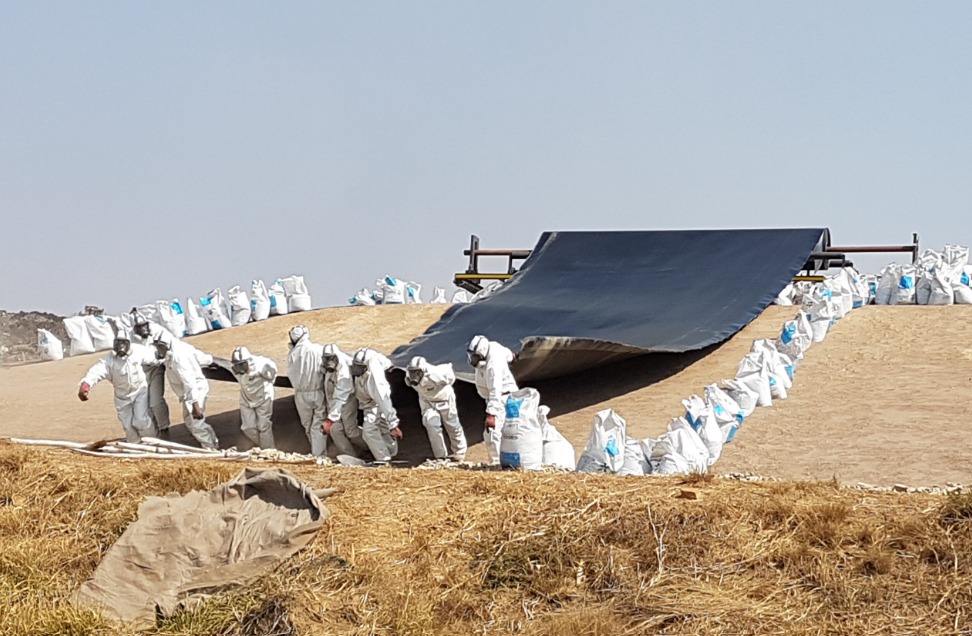
Mining operations need proper tailings storage
South Africans are not entirely unaware of what a TSF is. Hundreds of communities across the country live near TSFs. The most widely known ones are usually older tailings dams.
These are often large water systems that are easily mistaken for farm dams. While the systems that underpin these large facilities are in working condition, few problems occur. But when something does go wrong, like a dam wall bursting, it becomes national news.
That is why you need a trusted, effective and capable system that supports your TSF for decades to come. Gundle GeoSynthetics combines ISO- and SANS-certified quality systems, technically trained installation teams, and extensive geosynthetic engineering experience to support the construction of fit-for-purpose TSFs.
It is not just about having something to store your tailings; it is about keeping the community, your workers and the environment safe.
For more information on Gundle Geosynthetics’ robust HDPE Membranes, send an email to ggsales@gundleapi.co.za or visit www.gundlegeo.co.za
Related Posts